Stories of survival often end at the moment someone escapes danger.
The survivor is rescued. The music rises. The credits begin to roll.
But what happens the next morning?
How does someone return to ordinary life after experiencing something that has permanently changed the meaning of living?
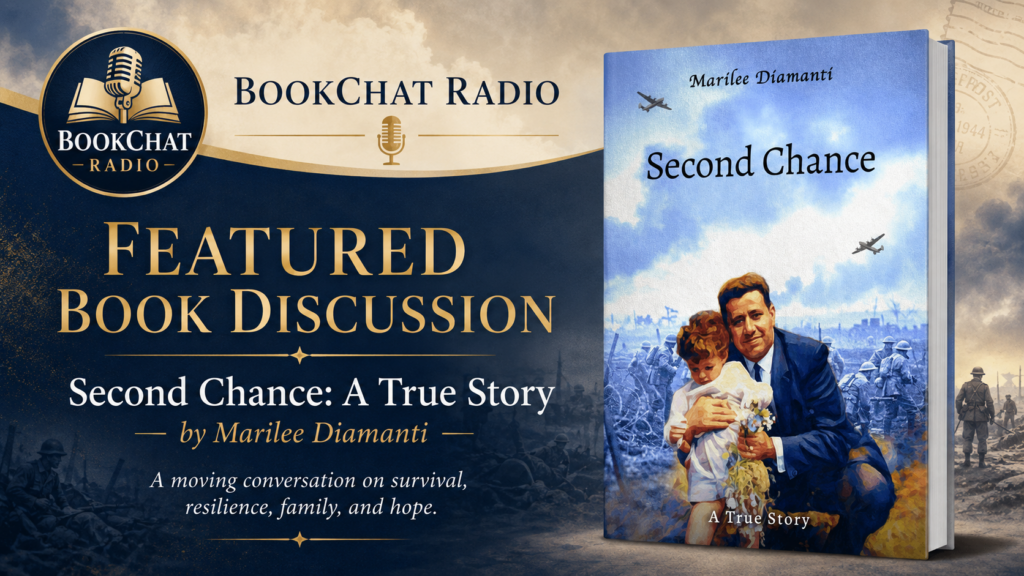
That question lies at the center of BookChat Radio’s powerful discussion of Marilee Diamanti’s historical memoir, Second Chance: A True Story.
The Story That Refused to Remain Silent
For Marilee Diamanti, writing had always been a private refuge—a place where she could organize her thoughts and express emotions that were difficult to communicate aloud.
Her father’s history, however, demanded something more.
It had lived quietly within the family through silences, losses, behaviors, and emotional patterns that were felt even when they were not openly discussed. The war was not simply a chapter in a history book. It remained present in the atmosphere of the family’s daily life.
The urgency to write arrived when Marilee’s children became old enough to understand the story. At the same time, members of the generation who had witnessed the events firsthand were beginning to pass away.
Remembering privately was no longer enough.
Without a permanent record, valuable testimony, details, and family memories could disappear. The book therefore became more than a personal writing project. It became an act of historical preservation.
Seeing Her Father as a Boy
One of the most emotionally transformative moments in Marilee’s research came when she reconstructed the details of her father’s experience.
Until then, Pavlos’s survival had existed as a powerful family story. Through research, however, the physical and emotional reality became immediate.
The change became even more profound when Marilee realized that her own son was approximately the same age Pavlos had been during those events.
She could no longer see Pavlos only as the strong adult who had raised her. She began to see him as a vulnerable young man facing circumstances that no teenager should ever have to confront.
That realization changed the meaning of his story—and the way she understood him as a father.
Learning to Understand Silence
Children do not always understand the emotional history their parents carry.
Silence can appear to be distance. Restraint can feel like emotional absence. A parent’s inability to discuss the past may be interpreted as a refusal to connect.
Writing Second Chance gave Marilee a different understanding of her father’s silences.
They were not empty spaces.
They were containers.
Some experiences cannot be translated easily into ordinary conversation. Trauma does not disappear when a war ends. It follows survivors into their homes, relationships, routines, and parenting decisions.
Marilee came to understand that her father’s silence was one of the ways he carried a history too painful and complicated for everyday language.
The Power of Restraint
Writing about trauma presents a difficult challenge. An author must communicate the severity of an event without sensationalizing the people who lived through it.
Too little detail can minimize the experience. Too much dramatic language can make the story feel manufactured or exploitative.
Marilee approached these moments with restraint.
Deep emotion in real life does not always arrive through dramatic speeches. It may appear through a pause, a gesture, an unfinished sentence, or a change in the atmosphere of a room.
By trusting those quieter details, the writing allows readers to encounter the emotion rather than simply being told how to feel.
This restraint also reflects Marilee’s sense of responsibility toward her father and the other people represented in the book. Their suffering was not material to be used for entertainment. Their memories deserved dignity.
Memory and Historical Truth
Family history often comes through fragmented recollections.
Different witnesses may remember the same event differently—not because one person is necessarily wrong, but because memory is shaped by perspective, emotion, trauma, and time.
During the BookChat Radio discussion, this process is compared to assembling a puzzle. Each person holds a meaningful piece of the truth, but no single recollection provides the entire picture.
This creates an important distinction between broad history and personal history.
Traditional history records battles, treaties, military operations, and political decisions. Personal history reveals how those events were experienced in homes, kitchens, prisons, streets, and whispered conversations.
One provides the map.
The other reveals what it felt like to walk through the landscape.
Marilee’s work brings those perspectives together. Historical research gives the story structure, while memory gives it a human voice.
Philotimo: The Moral Heart of the Story
A central concept in Second Chance is the Greek value of philotimo.
The word does not have a simple English translation. It includes honor, dignity, generosity, empathy, moral responsibility, and duty toward other people.
For Pavlos, philotimo became a way of living after the war.
Trauma can cause people to retreat inward, build emotional walls, or disconnect from others. Pavlos chose another path. He remained connected to family, community, compassion, and responsibility.
His strength was not demonstrated only by surviving the firing squad. It was demonstrated in refusing to allow suffering to destroy his humanity.
The same value guided Marilee’s writing. Preserving her father’s history required more than accuracy. It required respect. She had to honor the people behind the facts and resist turning their pain into spectacle.
Redefining the Second Chance
At first, the book’s title appears to refer to the moment Pavlos survived.
But the deeper meaning lies in what happened afterward.
A second chance is not a blank slate. It does not erase grief, trauma, or the consequences of what came before.
It is an awareness that life could have ended—and did not.
What matters is how that continued life is used.
Pavlos’s second chance existed in the family he raised, the compassion he preserved, the values he passed forward, and the daily decision to remain engaged with life.
Marilee also observes that second chances are rarely recognized when they begin. During the moment itself, people may still be frightened, uncertain, or simply focused on surviving another day.
Often, we live our second chances long before we understand them.
Only later can we look back and recognize the threshold we crossed.
A Legacy Preserved
By writing Second Chance, Marilee transformed a private family history into a shared legacy.
She preserved more than the details of her father’s wartime experience. She preserved his values, resilience, compassion, and way of moving through the world.
The book also reminds us that history is not limited to official records. It lives inside families—in inherited silences, emotional patterns, photographs, testimonies, and stories waiting to be told.
Pavlos’s life was shaped by a moment that could have ended everything. Yet his life cannot be defined only by that moment.
It must also be defined by everything he continued to become.
That may be the most important message of Second Chance: survival is not always a triumphant ending.
Sometimes, it is the quiet beginning of a life rebuilt one ordinary day at a time.
Discover the Story
Second Chance: A True Story by Marilee Diamanti is available on Amazon.
Learn more about the author and her work at mdiamanti.gr.